English
  Español

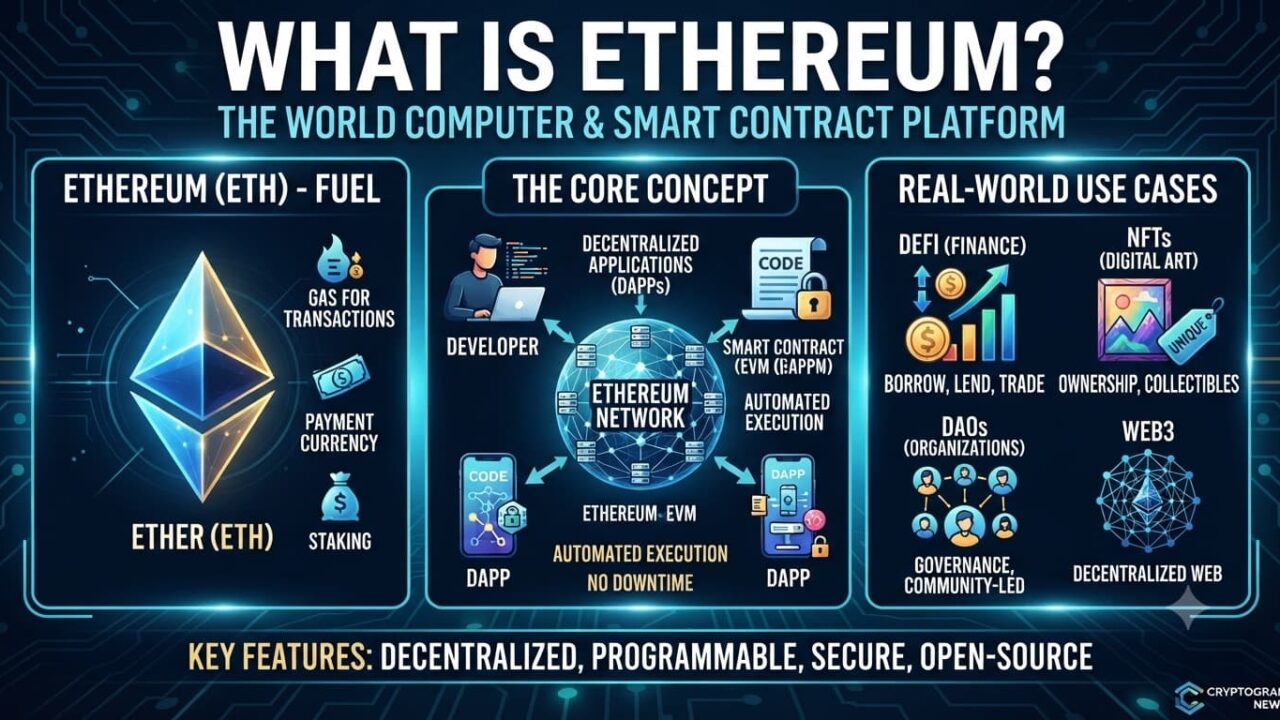

Ethereum is a decentralized, open-source blockchain platform launched in 2015 by Vitalik Buterin and a team of co-founders. Unlike Bitcoin, which was designed primarily as digital money, Ethereum was built as a programmable blockchain — a global computer that anyone can build applications on top of.
What Makes Ethereum Different From Bitcoin?
Bitcoin’s blockchain is optimized for one job: transferring value securely. Ethereum goes further by supporting smart contracts — self-executing pieces of code that automatically run when certain conditions are met, without needing a middleman like a bank, lawyer, or escrow service.
ETH / USD Real-Time Chart
This single feature unlocked an entire ecosystem:
- DeFi (Decentralized Finance) — lending, borrowing, and trading without banks
- NFTs (Non-Fungible Tokens) — unique digital assets representing art, collectibles, and more
- DAOs (Decentralized Autonomous Organizations) — community-governed organizations run by code
- Stablecoins — many major stablecoins run on Ethereum’s network
How Does Ethereum Work?
Ethereum moved from Proof of Work to Proof of Stake (PoS) in 2022 in an upgrade known as “The Merge,” dramatically cutting its energy consumption. Under PoS, validators lock up (stake) ETH as collateral to propose and confirm new blocks, earning rewards for honest participation and risking penalties for misbehavior.
Read Also
Every action on Ethereum — sending ETH, deploying a smart contract, minting an NFT — requires a small fee paid in ETH called “gas.” Gas fees compensate the network for computing power and prevent spam.
What Is Ethereum Used For?
- Network fuel — ETH pays for gas fees and transactions
- Investment asset — held as a long-term store of value
- Staking — earning yield by helping secure the network
- Collateral — used across DeFi lending and borrowing platforms
Ethereum’s Ecosystem in 2026
Ethereum remains the leading platform for smart contracts and hosts the largest share of DeFi’s total value locked (TVL). Layer 2 scaling solutions (such as rollups) have significantly reduced transaction costs while inheriting Ethereum’s security, making the network more accessible for everyday users.
BTC / USD Real-Time Chart
Ethereum vs. Bitcoin: Quick Comparison
| Feature | Bitcoin | Ethereum |
|---|---|---|
| Primary Purpose | Digital money | Programmable platform |
| Consensus | Proof of Work | Proof of Stake |
| Supply | Capped at 21M | No hard cap |
| Smart Contracts | No | Yes |
Getting Started With Ethereum
To buy or hold ETH, you’ll need a reliable exchange and a secure wallet. See our guides: Best Crypto Exchanges and Best Crypto Wallets. If you’re new to crypto overall, start with What Is Bitcoin? and What Is Blockchain? to build a strong foundation.
Frequently Asked Questions
Is Ethereum the same as ETH? Ethereum is the network/platform; ETH (Ether) is its native cryptocurrency.
Stay Ahead of the Curve
Join our weekly newsletter for exclusive insights.
Do I need ETH to use decentralized apps? Yes — you typically need ETH to pay gas fees for any interaction on the network.
Is Ethereum more environmentally friendly than Bitcoin? Since switching to Proof of Stake, Ethereum’s energy consumption dropped by over 99% compared to its previous Proof of Work model.