 English
 Español



- What Are Real-World Assets?
- How Does RWA Tokenization Work?
- Types of Tokenized Assets
- Tokenized government bonds and Treasury bills
- Real estate
- Gold and other commodities
- Private credit and corporate debt
- What Are the Main Benefits of RWAs?
- Fractional ownership
- Potentially faster settlement
- Greater transparency and automation
- Access to new investment opportunities
- What Do Industry Leaders and Researchers Say?
- What Are the Risks of Investing in RWAs?
- How to Evaluate an RWA Project
- The Future of Real-World Asset Tokenization
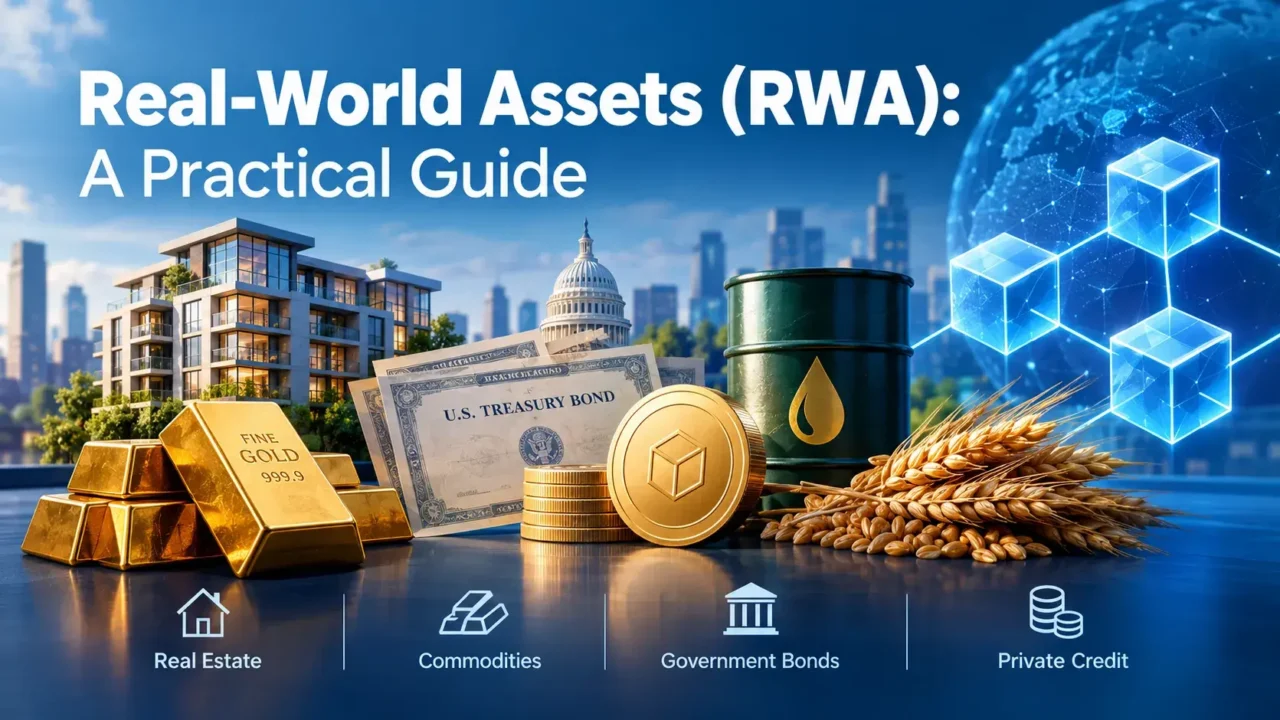
Real-world assets (RWAs) are traditional assets represented by digital tokens on a blockchain. From government bonds and gold to real estate and private credit, tokenization is creating new ways to access financial markets. But how does it work, and what risks should investors understand before buying an Real-world assets token?
What Are Real-World Assets?
Real-world assets are physical or financial assets whose value originates outside a blockchain but can be represented digitally on one. Common examples include real estate, precious metals, government bonds, corporate debt, investment funds and certain commodities.
The process of converting ownership interests or claims on these assets into digital tokens is called tokenization. A token can represent a direct ownership interest, a share in a legal entity that holds an asset, or a contractual claim against an issuer. These structures are not interchangeable, and the legal rights attached to each token matter.
According to Ethereum.org’s educational guide to RWAs, tokenization can make it possible to divide assets into smaller units and connect traditional financial markets with blockchain-based applications.
Read Also
For example, purchasing an entire commercial property may require substantial capital. A tokenized structure could allow eligible investors to acquire smaller interests in a property-holding entity instead. The token does not automatically make its holder the registered owner of the building: the legal documents determine what the investment actually represents.
How Does RWA Tokenization Work?
Tokenization generally involves several steps.
1. Identify and verify the underlying asset. The issuer establishes what asset exists, who owns it and how its value will be assessed. Independent audits, custody records and valuation reports may be important.
2. Establish the legal structure. The issuer determines whether tokens represent ownership, shares in a special-purpose vehicle, debt, or another contractual right. Applicable securities, property and financial regulations must be considered.
Stay Ahead of the Curve
Join our weekly newsletter for exclusive insights.
3. Issue digital tokens. A blockchain records the tokens and relevant transactions. Smart contracts can automate certain functions, such as transfers, eligibility checks and distributions, depending on how the system is designed.
4. Manage custody and ongoing obligations. The underlying asset must be safeguarded, insured where appropriate, valued and monitored. Issuers may also need to provide financial disclosures, process redemptions and distribute income.
5. Enable transfers or trading. Tokens may be offered through regulated platforms or other permitted marketplaces. Some can be transferred freely, while others restrict transactions to approved investors or wallets.
The blockchain provides a digital record, but it cannot independently guarantee that an off-chain asset exists, that the issuer owns it or that token holders can enforce their rights.
Types of Tokenized Assets
The RWA sector covers several asset classes, each with a different risk profile.
Tokenized government bonds and Treasury bills
Short-term government debt is one of the most prominent use cases. Tokenized funds can give eligible investors blockchain-based access to portfolios of government securities and related instruments.
These products may offer income linked to underlying holdings, subject to fees and fund terms. However, a token representing an interest in a fund is not necessarily the same as directly owning a government bond, and returns are not guaranteed.
Real estate
Property tokenization can divide economic interests in buildings or property-owning entities into smaller units. Investors may gain exposure to rental income or changes in property values without purchasing an entire building.
Nevertheless, real estate remains subject to maintenance costs, vacancies, local property laws and valuation uncertainty. Token holders must also understand who controls the property and how it can be sold.
Gold and other commodities
Digital tokens can represent claims on stored precious metals or other commodities. Their reliability depends on the issuer’s custody arrangements, verification procedures and redemption terms.
Investors should check whether the underlying commodity is independently audited, how much backs each token and whether physical redemption is possible.
Private credit and corporate debt
Some platforms use tokenization to distribute loans, debt instruments or interests in private-credit funds. Such products can provide access to financing markets that are difficult for individual investors to enter directly.
However, borrowers may default, repayments can be delayed, and secondary markets may be limited. A token does not eliminate the credit risk of the borrower.
What Are the Main Benefits of RWAs?
Fractional ownership
Tokenization can reduce the minimum investment required to obtain exposure to certain assets. Instead of buying an entire property or a large financial instrument, an investor may be able to purchase a smaller eligible interest.
Fractionalization improves divisibility, but it does not necessarily make an investment affordable or suitable for everyone. Minimums, fees, investor eligibility and transfer restrictions still apply.
Potentially faster settlement
Traditional financial transactions can involve multiple intermediaries, reconciliations and settlement processes. Blockchain-based systems can combine certain recordkeeping and transfer functions, potentially reducing delays and administrative costs.
In its 2025 Annual Economic Report, the Bank for International Settlements described tokenization as a potentially transformative development for payments and financial markets. Its benefits depend on the design of the system, the settlement asset and the surrounding infrastructure.
Greater transparency and automation
A blockchain can provide a shared transaction history, while smart contracts may automate specific rules. This can improve operational efficiency and make certain transactions easier to verify.
However, on-chain records do not necessarily disclose the complete financial condition of an issuer or prove the quality of an underlying asset. Independent reporting and off-chain verification remain essential.
Access to new investment opportunities
Tokenization may widen access to selected markets by lowering some operational barriers. It can also connect traditional financial products with blockchain-based lending, trading and portfolio-management applications.
Access is not universal, though. Investor eligibility requirements, local regulations and platform restrictions can prevent some users from participating.
What Do Industry Leaders and Researchers Say?
BlackRock CEO Larry Fink has been a prominent advocate of financial-market tokenization. In his 2025 annual chairman’s letter, Fink argued that tokenizing stocks, bonds and funds could improve market efficiency and broaden access to investment opportunities.
His position reflects the potential of the technology, but it should be understood as an industry leader’s strategic outlook rather than proof that all markets will adopt tokenization or that every tokenized product will succeed.
Regulators and researchers have taken a more cautious view of the implementation challenges. The Bank for International Settlements’ August 2025 analysis of tokenization and financial stability identified potential benefits, including greater efficiency and fractional ownership, while highlighting operational complexity, liquidity pressures and regulatory uncertainty.
More recently, a Global Risk Institute report published in August 2026 by Columbia University researchers Agostino Capponi and Brian Zhu emphasized that tokenization does not change the legal nature of the underlying asset or remove the need for investor protection.
Taken together, these perspectives point to a central conclusion: the technology may improve how assets are issued and transferred, but the quality of the legal structure, the issuer and the underlying investment remains decisive.
What Are the Risks of Investing in RWAs?
Despite the potential advantages, tokenized investments introduce risks that should not be overlooked.
Legal and ownership risk. A token may provide only a contractual claim rather than direct ownership. If the issuer becomes insolvent, investors’ ability to recover assets will depend on the legal structure and applicable law.
Counterparty and custody risk. Investors may rely on an issuer, custodian, property manager or other service provider. Fraud, mismanagement or insolvency can undermine the investment.
Smart-contract and cybersecurity risk. Software vulnerabilities, stolen private keys, compromised wallets and infrastructure failures can result in losses. Transactions may be difficult or impossible to reverse.
Liquidity risk. A token may be technically transferable but still have few buyers. Trading around the clock does not guarantee continuous liquidity or a fair market price.
Valuation and redemption risk. The token’s market price may diverge from the value of the underlying asset. Redemptions can be restricted, delayed or subject to fees and minimum requirements.
Regulatory risk. Rules governing securities, property rights, investor eligibility, taxation and digital assets differ across jurisdictions and may change.
Investors should examine the offering documents, independent audits, custody arrangements, fees, redemption conditions and dispute-resolution procedures before committing funds.
How to Evaluate an RWA Project
Before buying a token, ask five practical questions:
- What do I legally own? Identify the precise rights attached to the token and whether those rights are enforceable in your jurisdiction.
- Does the underlying asset exist? Look for credible third-party audits, custody evidence and transparent valuation methods.
- Who is responsible? Research the issuer, custodian, asset manager and any other key service providers.
- Can I sell or redeem it? Understand transfer restrictions, redemption windows, fees and the actual depth of the secondary market.
- What happens if something goes wrong? Review insolvency protections, dispute procedures, smart-contract audits and recovery arrangements.
Do not rely solely on a project’s website, token price or advertised yield. Independent verification matters more than marketing claims.
The Future of Real-World Asset Tokenization
Tokenization could become an important part of financial-market infrastructure, particularly where it simplifies asset issuance, recordkeeping and settlement. Government securities, investment funds, private credit and selected property investments are natural areas to watch.
Yet widespread adoption will depend on more than blockchain technology. Legal recognition, investor safeguards, reliable custody, interoperability between platforms and sufficient market liquidity are all necessary for sustainable growth.
For investors, the most useful approach is to separate technological potential from investment quality. A well-designed token can make an asset easier to access or transfer, but it cannot automatically make the underlying investment safer, more profitable or more liquid.
The bottom line: RWAs connect traditional assets with blockchain-based financial infrastructure. Their long-term value will depend on enforceable ownership rights, transparent operations, responsible regulation and genuine investor demand—not tokenization alone.
Disclaimer: This article is for educational and informational purposes only. It does not constitute financial, investment, legal or tax advice. Tokenized assets can lose value, and investors should conduct independent due diligence before making financial decisions.