English
  Español


- What happened to Binance’s European licensing effort?
- What does the Lagarde report say?
- Why Binance’s compliance history matters
- Expert opinion: Lagarde’s broader concerns about crypto
- Binance says Europe remains a priority
- What MiCA means for European crypto users
- What happens next?
- The bigger picture for crypto regulation
Binance’s attempt to secure a Europe-wide regulatory foothold through Greece has become the subject of a new dispute over how far European policymakers should go in scrutinizing major cryptocurrency exchanges.
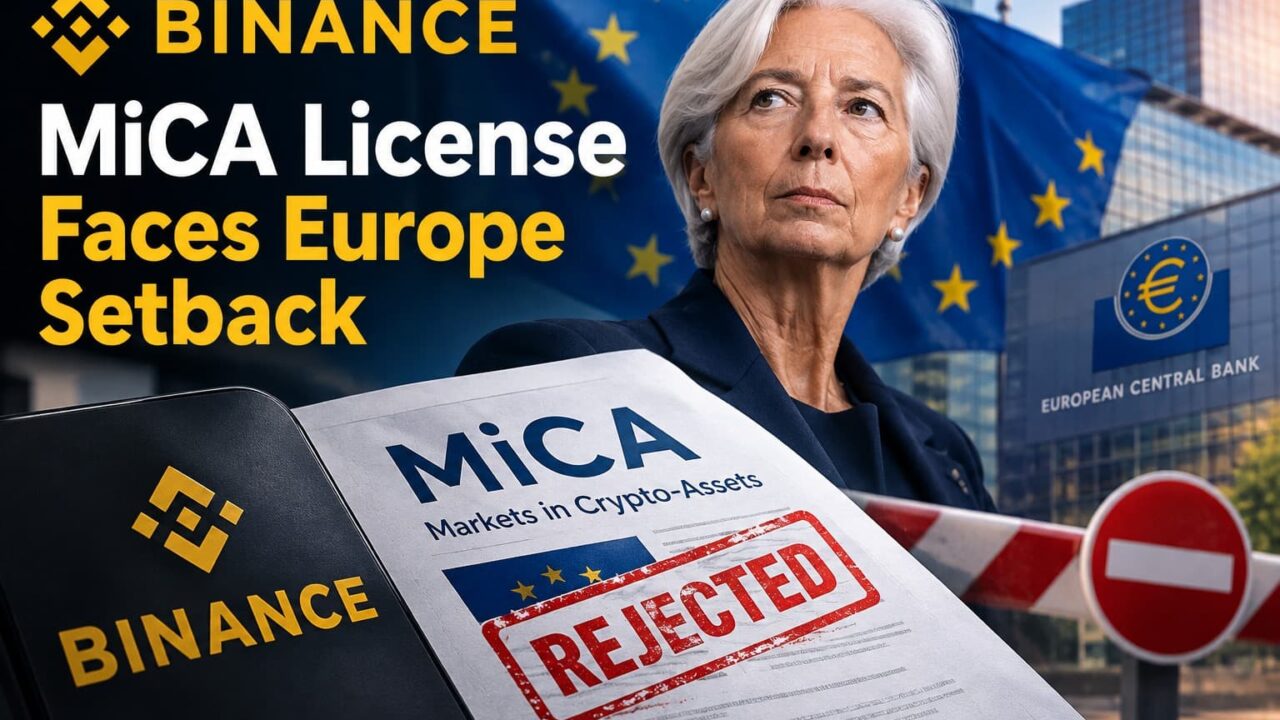
A report published by The Wall Street Journal says European Central Bank President Christine Lagarde played a role in stopping Binance’s effort to obtain a Markets in Crypto-Assets, or MiCA, authorization through Greece. The report describes concerns among European officials about Binance’s previous compliance record and the potential implications of allowing the exchange to expand its presence across the European Union.
BTC / USD Real-Time Chart
The situation is significant because a MiCA authorization obtained in one EU member state can provide a regulatory passport for crypto-asset services across the bloc. For Binance, Greece was therefore more than a local licensing opportunity: it could have provided a route to a broader European market.
Binance has disputed aspects of the regulatory account and has maintained that it has worked constructively with European regulators. The company ultimately withdrew its Greek application in June and said it would pursue authorization in another EU member state.
Read Also
What happened to Binance’s European licensing effort?
Binance spent months seeking authorization from Greece’s Hellenic Capital Market Commission (HCMC) under the EU’s MiCA framework.
The regulatory framework introduced a common set of rules for crypto-asset service providers operating in the European Union. Transitional provisions allowed certain providers already operating legally under national rules to continue during a limited period. ESMA states that this transitional period could run until July 1, 2026, or until authorization was granted or refused, whichever came first.
ETH / USD Real-Time Chart
That deadline put considerable pressure on exchanges that had not obtained a MiCA authorization.
In June, Reuters reported that Binance’s Greek application was expected to be rejected. Binance responded at the time that it believed its application met MiCA requirements and said it had worked with regulators for approximately 18 months.
Stay Ahead of the Curve
Join our weekly newsletter for exclusive insights.
On June 24, Binance officially announced that it had withdrawn its Greek application. The company said it intended to seek authorization in another EU member state.
That distinction is important. The Greek application was withdrawn, but Binance did not announce that it was abandoning Europe.
What does the Lagarde report say?
According to The Wall Street Journal, Lagarde intervened during discussions involving the Greek government and raised concerns about Binance’s regulatory history.
The report says that Lagarde was concerned about the exchange’s previous criminal and compliance issues and about the broader implications of allowing Binance to establish a stronger position in the European market.
The ECB does not formally issue MiCA licenses to crypto exchanges. Licensing decisions are handled by national competent authorities, such as Greece’s HCMC. Consequently, any role attributed to Lagarde would represent political or institutional influence rather than the ECB directly granting or denying a crypto authorization.
That distinction is central to understanding the story.
The reported intervention does not mean that the ECB replaced Greece’s financial regulator. Rather, the WSJ account describes discussions at a senior European policy level that allegedly affected the environment in which the Greek application was considered.
Neither the regulatory process nor the reported conversations should be interpreted as a formal ECB licensing decision.
Why Binance’s compliance history matters
Binance’s regulatory history is one of the central issues surrounding the European debate.
The exchange agreed in 2023 to pay a multibillion-dollar settlement in the United States after pleading guilty to violations involving anti-money-laundering and sanctions requirements. The company subsequently placed greater emphasis on compliance and regulatory licensing under CEO Richard Teng.
Binance has repeatedly argued that its compliance infrastructure has changed substantially.
In a June 2026 update, the company said it had more than 1,500 people working in compliance roles and had invested heavily in controls and monitoring systems. Binance also said it remained committed to securing authorization under MiCA.
Those claims represent the company’s own description of its compliance transformation and should be distinguished from independent regulatory assessments.
The European licensing debate therefore involves two competing considerations: whether Binance’s current controls satisfy MiCA requirements and how regulators should weigh the company’s historical compliance record when evaluating authorization.
Expert opinion: Lagarde’s broader concerns about crypto
Lagarde has publicly discussed risks associated with digital assets and stablecoins beyond the Binance case.
In a May 2026 speech, the ECB president said stablecoins had moved rapidly from a peripheral financial product to a central issue in monetary and financial policy. She highlighted concerns about financial stability as stablecoins become more closely connected to the traditional financial system.
Her comments provide useful context for the broader regulatory approach in Europe.
However, those remarks should not automatically be interpreted as a statement that Binance itself presents a specific financial-stability threat. The Binance licensing dispute involves company-specific compliance questions, while Lagarde’s public comments address wider risks associated with stablecoins and digital assets.
That distinction is important when assessing the reported Greek decision.
Binance says Europe remains a priority
Binance has consistently rejected the idea that its European strategy is ending.
Gillian Lynch, Binance’s head of Europe and the United Kingdom, told Reuters in June that the company was not leaving Europe and could pursue a different route to authorization.
Binance subsequently confirmed that it had withdrawn its Greek application and intended to seek authorization in another EU member state.
The company’s position is therefore relatively clear: the Greek route failed, but its European strategy continues.
The practical question is where Binance will seek authorization next and whether European regulators will accept the company’s revised compliance framework.
What MiCA means for European crypto users
MiCA was designed to create a harmonized regulatory framework for crypto-asset services across the European Union.
For users, the framework is intended to make the regulatory status of crypto providers clearer and establish common requirements covering areas such as consumer protection, market conduct and organizational standards.
For exchanges, however, authorization can become a significant operational hurdle.
ESMA has warned that crypto-asset service providers without the required authorization after the applicable transitional period must stop providing unauthorized services. The European regulator has also instructed national authorities to monitor orderly wind-down arrangements and customer migration where necessary.
This means Binance’s European situation is not simply a dispute involving one company. It is also a test of how consistently MiCA is applied across the EU.
What happens next?
Binance’s next licensing application will be closely watched by the crypto industry.
A successful application in another EU member state could eventually give the exchange a regulated pathway back into broader European operations. A prolonged licensing process, meanwhile, could create additional uncertainty for European customers and increase the importance of locally authorized competitors.
The outcome could also influence how other large global crypto platforms approach European regulation.
For users, the most important issue is to verify the regulatory status of the specific legal entity providing services to them. ESMA has advised consumers to check whether a provider appears in its MiCA register rather than assuming that authorization of one company within a corporate group automatically applies to every related entity.
The bigger picture for crypto regulation
The Binance case illustrates a broader shift in European cryptocurrency policy.
The era in which a global exchange could approach European markets primarily through national registrations is being replaced by a more structured regulatory system. MiCA provides a common framework, but individual national regulators remain important participants in the authorization process.
The reported involvement of senior European officials adds another layer to that process. If the WSJ account is accurate, it demonstrates how licensing decisions involving major crypto companies can intersect with broader questions about financial stability, sanctions compliance, anti-money-laundering controls and Europe’s digital-finance strategy.
At the same time, Binance’s continuing efforts to obtain European authorization show that the company views the EU market as strategically important.
For now, the Greek application is closed. The next chapter will depend on where Binance applies, how regulators evaluate its current compliance framework and whether the exchange can obtain authorization under the post-transition MiCA regime.
For European crypto users and the wider digital-asset industry, the outcome could provide an important indication of how strictly Europe’s new regulatory framework will be applied to the world’s largest cryptocurrency exchanges.
Disclaimer: This article is for informational purposes only and does not constitute financial, investment, legal or regulatory advice. Cryptocurrency markets involve significant risks. Regulatory requirements can change, and readers should verify the current authorization status of any crypto-asset service provider with the relevant regulator before using its services.