English
  Español

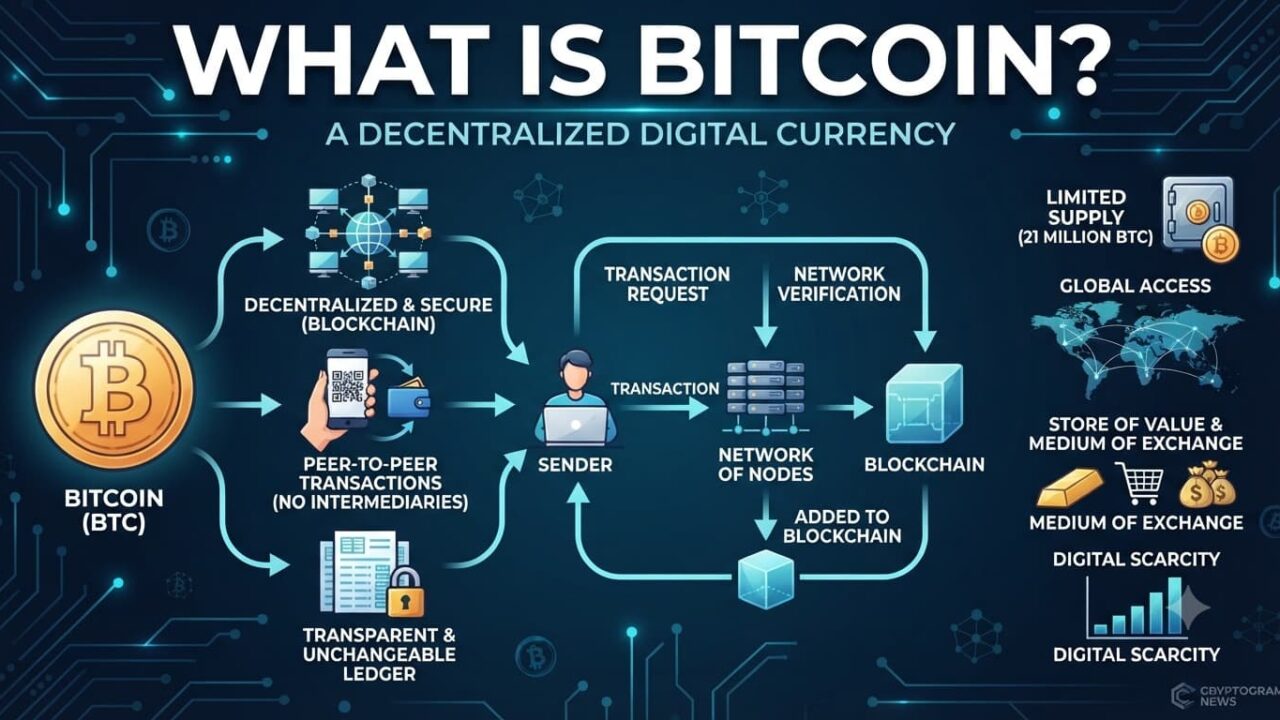

Bitcoin (BTC) is the world’s first and largest cryptocurrency — a form of digital money that runs without banks, governments, or any central authority. Created in 2009 by an anonymous person (or group) using the name Satoshi Nakamoto, Bitcoin introduced a completely new way to send and store value online.
How Does Bitcoin Work?
Bitcoin runs on a public, decentralized ledger called a blockchain. Every transaction is grouped into “blocks,” verified by a global network of computers, and permanently recorded in chronological order. No single company or government controls this ledger — instead, thousands of independent computers (called nodes) keep copies of it and agree on which transactions are valid.
BTC / USD Real-Time Chart
This process relies on a mechanism called Proof of Work (PoW). Specialized computers called miners compete to solve complex mathematical puzzles. The winner adds the next block to the chain and receives a reward in newly created BTC — this is how new bitcoins enter circulation.
Key Features of Bitcoin
- Fixed supply — only 21 million BTC will ever exist, making it scarce by design.
- Decentralization — no single entity can shut it down or manipulate the ledger.
- Transparency — anyone can view every transaction on the public blockchain.
- Borderless — BTC can be sent anywhere in the world in minutes, without a bank.
- Pseudonymity — transactions are linked to wallet addresses, not names.
What Is Bitcoin Used For?
- Store of value — often called “digital gold,” held as a long-term investment or inflation hedge.
- Payments — an increasing number of merchants and platforms accept BTC directly.
- Remittances — sending money across borders faster and often cheaper than traditional banking.
- Portfolio diversification — many investors hold BTC alongside stocks and other assets.
Is Bitcoin Safe?
Bitcoin’s protocol has never been hacked since its 2009 launch, but safety ultimately depends on how you store and manage your own coins. Losing your private key means losing access to your funds, and scams targeting beginners remain common. That’s why understanding wallets and exchanges (see our guides linked below) is just as important as understanding Bitcoin itself.
Read Also
Bitcoin vs. Traditional Money
| Feature | Bitcoin | Traditional Currency |
|---|---|---|
| Issuer | No central authority | Central banks |
| Supply | Capped at 21 million | Can be printed indefinitely |
| Settlement | Minutes, 24/7 | Days, business hours only |
| Custody | Self-custody possible | Bank-controlled |
Getting Started
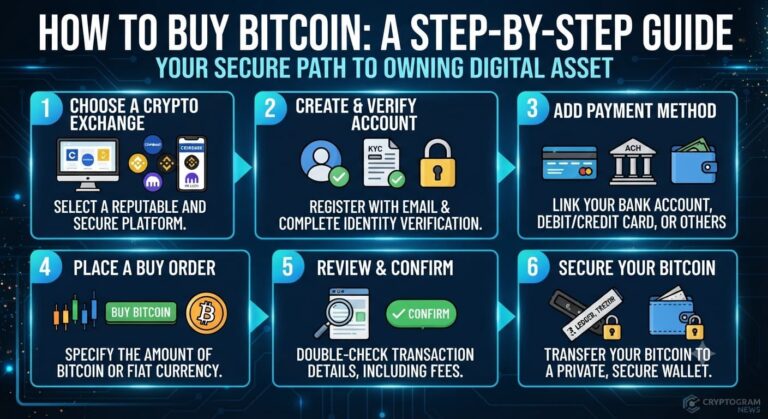
If you’re ready to buy your first Bitcoin, read our step-by-step guide: How to Buy Bitcoin. You’ll also want a secure place to store it — check our comparison of the Best Crypto Wallets and Best Crypto Exchanges.
To understand the technology behind Bitcoin in more depth, read: What Is Blockchain?
ETH / USD Real-Time Chart
Frequently Asked Questions
Is Bitcoin legal? Bitcoin is legal in most countries, though regulations vary. Always check local laws before trading.
Can Bitcoin be destroyed or banned? Because it’s decentralized across thousands of nodes worldwide, Bitcoin cannot be “turned off” by a single country or company.
How many bitcoins are left to mine? As of 2026, the vast majority of the 21 million BTC supply has already been mined, with the remainder released gradually until around the year 2140.