English
  Español


A Shift in Financial Paradigm
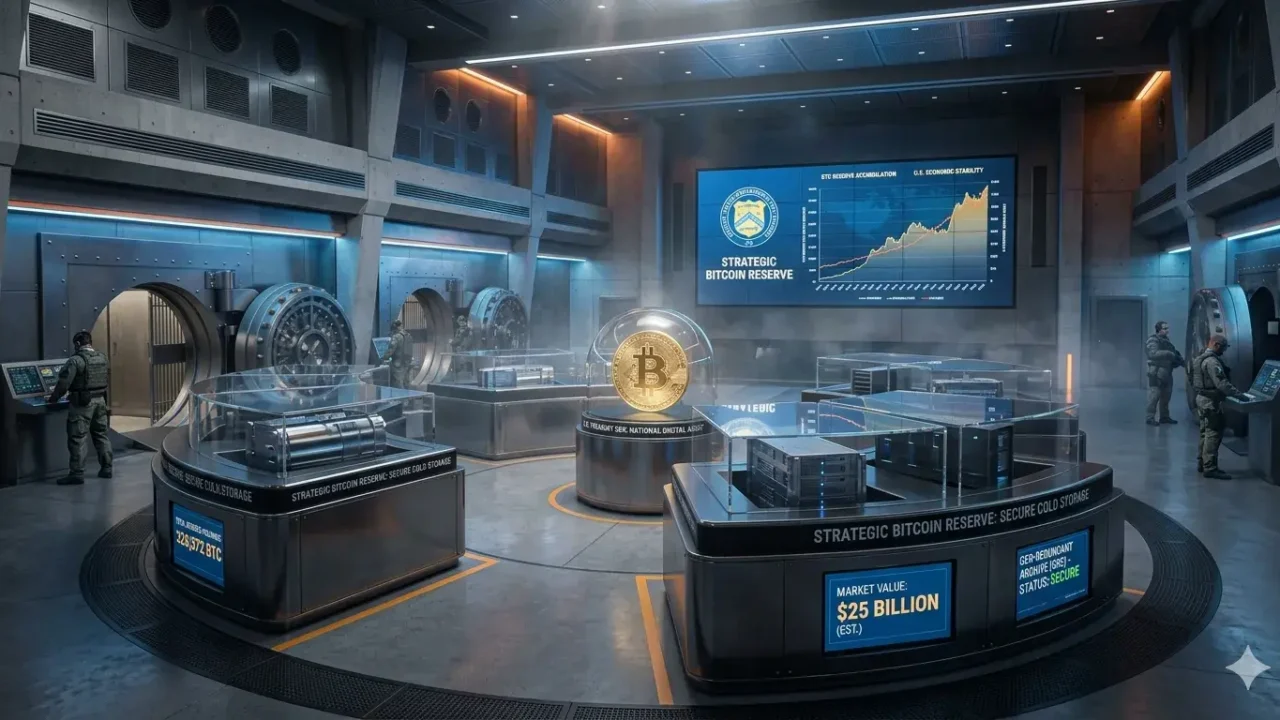
The conversation surrounding the “Strategic Bitcoin Reserve” (SBR) has evolved from speculative discourse to a cornerstone of U.S. digital asset policy. Established by President Donald Trump through an executive order in March 2025, the initiative marks a historic pivot: rather than liquidating seized assets, the U.S. government is centralizing them into a permanent reserve. As the federal government sits on approximately 328,372 BTC—valued at roughly $25 billion—this “virtual Fort Knox” is no longer a fringe concept but a serious component of national treasury strategy.
Understanding the Strategic Bitcoin Reserve
At its core, the SBR is a custodial framework managed by the Department of the Treasury. Unlike previous practices where forfeited Bitcoin was auctioned off to return value to victims or treasury accounts, the SBR treats Bitcoin as a national reserve asset, similar to gold or foreign currency.
- Centralized Custody: The executive order mandated that all government-held Bitcoin, primarily acquired through civil and criminal forfeitures, be moved into a single, centralized account.
- Budget-Neutral Acquisitions: While the government is not currently engaged in aggressive market purchases, the policy framework allows for future acquisitions if they can be executed in a “budget-neutral” manner.
- Digital Asset Stockpile: Alongside the Bitcoin reserve, a separate “U.S. Digital Asset Stockpile” was created for non-Bitcoin assets, which may be subject to liquidation, unlike the permanent Bitcoin holdings.
Expert Perspectives and Political Landscape
The initiative has drawn a spectrum of reactions from economists and policymakers. Proponents argue that a Bitcoin reserve serves as a hedge against fiat currency debasement and geopolitical instability. By positioning itself as a leader in digital asset storage, the U.S. aims to secure a stronger standing in global financial diplomacy.
Read Also
However, the path to codification remains complex. While the administration has cleared significant legal hurdles regarding the centralization of these assets, White House digital asset advisor Patrick Witt has emphasized that permanent Congressional legislation is still required to fully protect taxpayers and formalize the reserve’s status.
- Bipartisan Interest: Legislative efforts, such as the American Reserve Modernization Act introduced by Rep. Nick Begich, highlight that the desire for a strategic reserve is gaining bipartisan traction, moving beyond partisan lines.
- Economic Criticism: Conversely, some academic circles remain skeptical. A survey by the University of Chicago found that many economists are wary of borrowing money to build such a reserve, questioning whether holding crypto assets truly lowers the risks inherent in a central bank’s portfolio.
Geopolitical Implications
The U.S. focus on a Bitcoin reserve often surfaces in discussions regarding international relations and economic competition. Reports have noted Treasury efforts to freeze crypto networks tied to regimes like Iran, which reportedly manages significant digital assets. As the U.S. consolidates its “war chest” of 328,372 BTC, the move is frequently framed by supporters as a way to counter China’s financial influence and demonstrate the potential of decentralized finance (DeFi) to enhance national economic resilience.
ETH / USD Real-Time Chart
Looking Ahead: The Path to Midterms
As the administration prepares for further announcements, market observers are watching to see if the SBR will be codified into law before the upcoming midterms. The ongoing maturation of the crypto market—characterized by deepening liquidity and institutional adoption—suggests that Bitcoin’s role as a sovereign asset is only likely to grow.
For investors and citizens alike, the Strategic Bitcoin Reserve represents more than just a treasury ledger; it is a sign of a “digitally native economic future”. Whether it becomes a definitive tool for inflation management or remains a symbolic, albeit massive, store of value, the U.S. government’s stance on Bitcoin has fundamentally changed the landscape of global finance.