English
  Español


- What’s Inside the Pyrrho Upgrade
- 1. TVM Compatibility with Ethereum Pectra and Osaka
- 2. API Migration from fastjson to Jackson
- 3. Monitoring Migration from InfluxDB to Prometheus
- 4. Event Plugin Upgraded to v3.0.0
- Why the August 16 Deadline Matters
- Expert Perspective
- What Node Operators Should Do Now
- The Bigger Picture
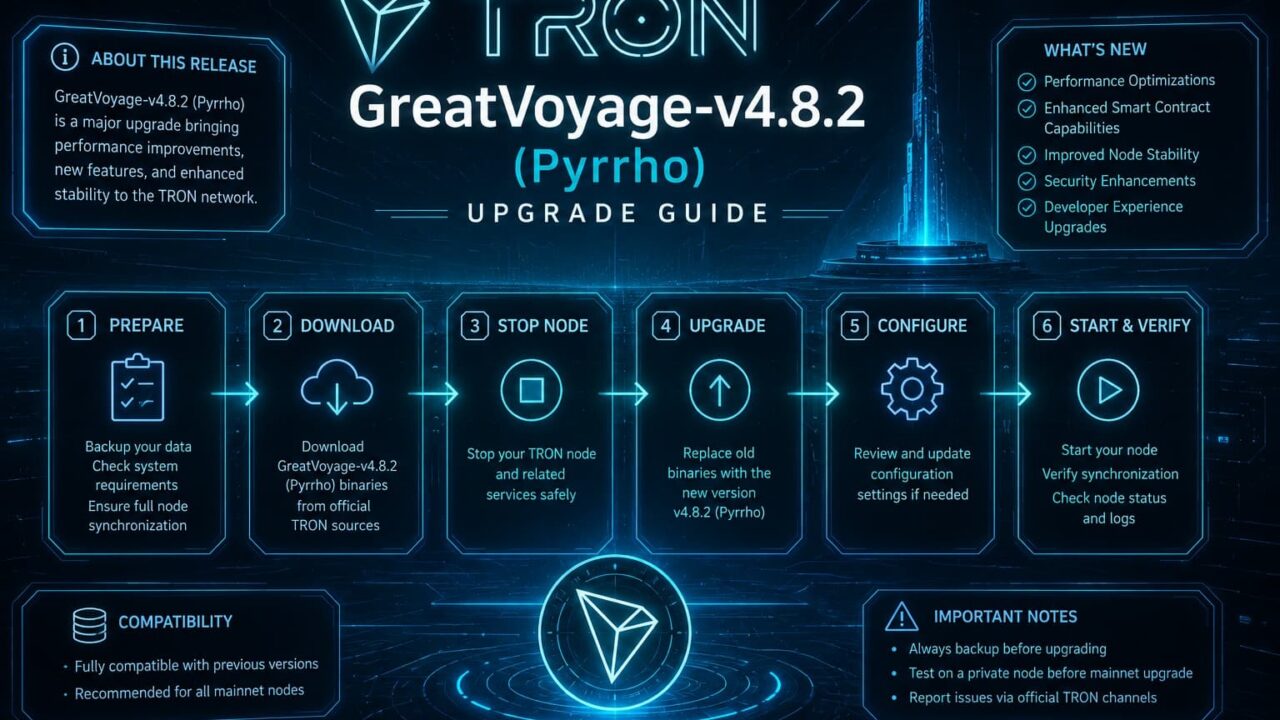
TRON has officially rolled out GreatVoyage-v4.8.2 (Pyrrho), the network’s latest mandatory mainnet upgrade, and the clock is now running for node operators, exchanges, and validators (Super Representatives) to get compliant. According to the announcement from TRON DAO, all nodes must complete the upgrade by August 16, 2026, 23:59 SGT, or risk falling out of sync with the rest of the network.
This isn’t a routine point release. GreatVoyage-v4.8.2 (Pyrrho) bundles a set of protocol, API, and infrastructure changes that touch everything from smart contract execution to how node operators monitor their systems day to day. Below is a breakdown of what’s changing, why it matters, and what teams running TRON infrastructure should do right now.
What’s Inside the Pyrrho Upgrade
The upgrade introduces four major changes to the TRON network:
Read Also
1. TVM Compatibility with Ethereum Pectra and Osaka
Perhaps the headline feature of GreatVoyage-v4.8.2 (Pyrrho) is deeper alignment between the TRON Virtual Machine (TVM) and Ethereum’s most recent hard forks, Pectra and Osaka. This includes support for a new Count Leading Zeros (CLZ) opcode, which speeds up the binary arithmetic that underpins optimized math libraries used in DeFi protocols, oracles, and cryptographic verification contracts.
For developers building cross-chain or EVM-portable applications, this kind of compatibility work matters more than it might seem at first glance. Every gap between the TVM and the EVM is a gap that developers have to manually patch when porting Solidity contracts between Ethereum and TRON. Closing that gap lowers the cost of deploying and maintaining multi-chain applications – a priority TRON has repeatedly emphasized as USDT settlement volume on its network has grown.
BTC / USD Real-Time Chart
2. API Migration from fastjson to Jackson
TRON is retiring fastjson in favor of Jackson for its API layer. This is largely a backend and security-hardening move. fastjson has a documented history of vulnerabilities that have prompted major Java-based platforms to migrate away from it in recent years, and Jackson is the more actively maintained, widely audited standard in the Java ecosystem. For most dApp developers and API consumers, this change should be invisible – but node operators running custom tooling against TRON’s JSON API should test for compatibility before the deadline.
3. Monitoring Migration from InfluxDB to Prometheus
Node operators who rely on TRON’s built-in monitoring stack will see a shift from InfluxDB to Prometheus. Prometheus has become something of a default choice for blockchain infrastructure monitoring because of its pull-based metrics model and native integration with Grafana dashboards and alerting tools like Alertmanager. Teams running monitoring pipelines tied to InfluxDB-specific queries will need to rebuild those dashboards against Prometheus metrics endpoints as part of their upgrade process.
Stay Ahead of the Curve
Join our weekly newsletter for exclusive insights.
4. Event Plugin Upgraded to v3.0.0
This is the change TRON DAO is flagging as the most operationally urgent. Any node running the TRON Event Plugin — used to stream on-chain events to external services such as exchanges, wallets, and block explorers – must upgrade the plugin to v3.0.0 before installing the new mainnet client, not after. Sequencing matters here: installing the mainnet upgrade first, without first updating the plugin, is a known path to synchronization failures and event-stream downtime.
Why the August 16 Deadline Matters
TRON has a consistent track record of framing its GreatVoyage releases as “mandatory,” and the language isn’t just formality. Mandatory upgrades typically include consensus-layer or transaction-processing changes that create a hard fork at the protocol level. Once enough of the network adopts the new client, nodes still running the old version stop being able to validate new blocks correctly, which effectively knocks them off the chain.
For exchanges, wallet providers, and custodians running TRON full nodes, that translates into a very concrete risk: missed deposits, stalled withdrawals, and broken event feeds for end users if the upgrade isn’t completed in time.
Expert Perspective
Infrastructure engineers who track TRON’s release cadence note that this cycle is heavier on backend and observability changes than previous mandatory upgrades, which more often focused narrowly on EVM-opcode parity. “The fastjson-to-Jackson and InfluxDB-to-Prometheus swaps aren’t glamorous, but they’re the kind of housekeeping that reduces attack surface and operational fragility over time,” one blockchain infrastructure consultant who advises exchange node operators told CryptogramNews. Analysts covering TRON’s broader 2026 roadmap have also pointed out that this release lands alongside a separate, still-in-testing initiative on TRON’s Nile testnet to build post-quantum signature support – a signal that the TRON developer community is treating both near-term EVM parity and longer-term cryptographic resilience as parallel priorities rather than competing ones.
Developer commentary in TRON’s GitHub release threads has also flagged the Event Plugin sequencing requirement as the most common source of upgrade errors in past mandatory releases, reinforcing TRON DAO’s emphasis on upgrading the plugin first.
What Node Operators Should Do Now
- Check your current version. Confirm which java-tron client version and Event Plugin version you’re currently running.
- Upgrade the Event Plugin to v3.0.0 first, if your node uses it, before touching the mainnet client.
- Install the Pyrrho mainnet client following TRON’s official deployment instructions and verify the release package’s GPG signature.
- Rebuild monitoring dashboards that depend on InfluxDB queries to instead pull from Prometheus endpoints.
- Test any custom API integrations that parse fastjson-formatted responses against the new Jackson-based output.
- Complete the process before August 16, 2026, 23:59 SGT to avoid falling out of sync with mainnet.
The Bigger Picture
The Pyrrho upgrade is one more entry in a fast-moving 2026 for TRON, a year that has already included a dismissal of SEC claims against the TRON Foundation, record USDT supply on the network, and a string of institutional integrations. Keeping the TVM aligned with Ethereum’s latest upgrades while modernizing the node software’s internals is part of how TRON has positioned itself as reliable settlement infrastructure for stablecoin volume – a positioning that depends heavily on node operators and exchanges actually keeping pace with mandatory upgrades like this one.
For now, the practical takeaway for anyone running TRON infrastructure is straightforward: don’t wait until mid-August. Sequencing errors, particularly around the Event Plugin, have caused avoidable outages in past upgrade cycles, and this upgrade gives operators several weeks of runway to test changes in a staging environment before the mandatory cutoff.