Real World Assets (RWA) Crypto Boom: Why 2026 is the Year of Tokenization
The digital asset landscape has officially moved beyond the era of “vaporware” and speculative memes. As we navigate the first quarter of 2026, the most significant trend dominating the headlines isn’t a new dog-themed coin or a pixelated NFT collection. Instead, it is the quiet, massive migration of global finance onto the blockchain. Welcome to the era of RWA crypto, where the trillions of dollars locked in traditional markets are being “unlocked” through the power of tokenization.
While 2024 and 2025 were years of experimentation, 2026 has become the year of implementation. With institutional heavyweights like BlackRock, JPMorgan, and Franklin Templeton moving from pilot programs to full-scale commercial offerings, the rwa crypto sector has seen its total value locked (TVL) explode, recently surpassing the $40 billion mark (excluding stablecoins).
What is RWA Crypto? Bridging the Gap Between TradFi and DeFi
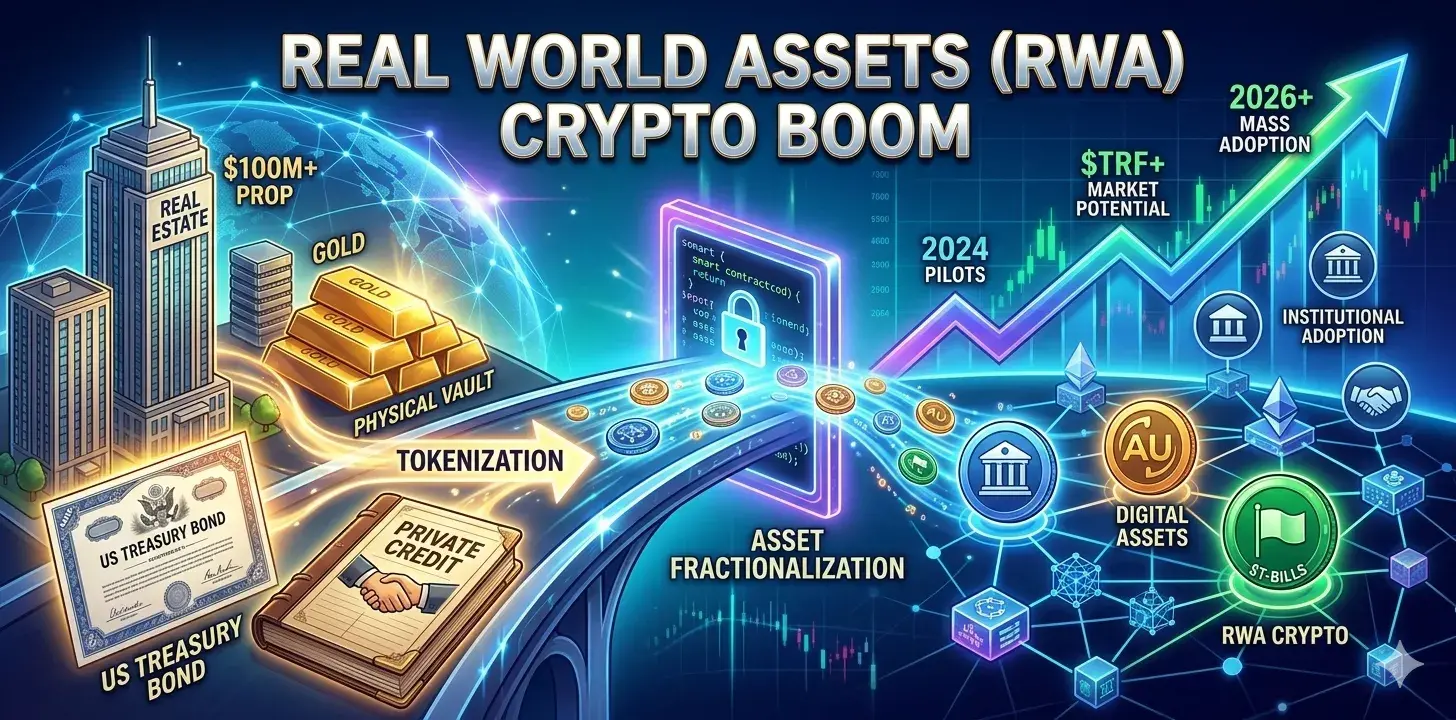
At its core, real world assets crypto refers to the process of bringing tangible or intangible assets from the traditional financial world—such as US Treasuries, real estate, private credit, and gold—onto a blockchain. This is achieved through tokenization, where a digital token on a network like Ethereum or Solana represents a claim on the underlying asset.
The primary goal of rwa crypto is to marry the stability and value of traditional finance (TradFi) with the efficiency, transparency, and 24/7 liquidity of decentralized finance (DeFi). By doing so, assets that were once “stuck” in slow, paper-based systems can now be traded, used as collateral, or fractionalized with the click of a button.
The “BlackRock Effect”: Institutional Validation at Scale
If there is one entity responsible for the current rwa crypto boom, it is BlackRock. The world’s largest asset manager sent shockwaves through the industry in 2024 with the launch of its BUIDL fund (BlackRock USD Institutional Digital Liquidity Fund).
The BUIDL Fund and the Uniswap Milestone
By early 2026, the BUIDL fund has grown to nearly $2.5 billion in assets under management. However, the true turning point occurred just weeks ago, in February 2026, when BlackRock made the historic move to list BUIDL on Uniswap, the world’s leading decentralized exchange.
This move allowed whitelisted institutional investors to trade tokenized assets directly against stablecoins in a permissioned DeFi environment. This integration signifies the “Holy Grail” of the rwa crypto movement: the ability for a Wall Street fund to exist and settle within a decentralized ecosystem, proving that the tech is finally ready for “prime time.”
Top Asset Classes Leading the RWA Boom
The variety of real world assets crypto available today is staggering. While early adoption was limited to a few sectors, 2026 has seen a diversification into virtually every corner of finance.
1. Tokenized Treasuries and Fixed Income
U.S. Treasuries remain the “king” of the rwa crypto space. In a high-interest-rate environment, crypto-native investors have flocked to tokenized T-bills to earn “risk-free” yield without leaving the blockchain. Protocols like Ondo Finance ($ONDO) and Franklin Templeton have led this charge, with tokenized government debt now accounting for over $10 billion in on-chain value.
2. Private Credit and Corporate Debt
For years, the private credit market was the exclusive playground of institutional funds and ultra-high-net-worth individuals. Today, platforms like Centrifuge ($CFG) and Maple Finance are utilizing tokenization to allow small-to-mid-sized enterprises to access on-chain capital. This sector is currently the fastest-growing niche in rwa crypto, providing essential liquidity to businesses in emerging markets.
3. Real Estate and Fractional Ownership
Real estate has always been an illiquid asset. Buying an apartment building requires millions of dollars and months of legal work. Through tokenization, a $50 million office building can be split into 50,000 digital tokens. This allows a retail investor in Tokyo to own $1,000 worth of a warehouse in Miami, receiving their share of the rent automatically via smart contracts.
Why Tokenization is Transforming Global Markets
Why are institutions so obsessed with rwa crypto? The answer lies in the fundamental flaws of the current financial system, which still relies on legacy technology from the 1970s.
Liquidity and 24/7 Global Trading
Traditional stock and bond markets close on weekends and holidays. If a crisis happens on a Saturday, you are stuck until Monday morning. Real world assets crypto trade 24/7, 365 days a year. Furthermore, the ability to “fractionalize” assets increases liquidity by lowering the barrier to entry for millions of new investors.
Settlement Efficiency and Transparency
In the traditional world, settling a trade can take two to three days (T+2 or T+3). On the blockchain, settlement is near-instant (T+0). Additionally, every transaction and ownership record is stored on a public ledger, eliminating the need for expensive audits and reducing the risk of fraud. This efficiency is a core reason why the rwa crypto sector is projected to reach $16 trillion by 2030.
The Role of Infrastructure: Oracles and Layer-2s
The rwa crypto boom wouldn’t be possible without the “plumbing” that connects the real world to the blockchain.
- Oracles: Networks like Chainlink ($LINK) provide the critical price feeds that tell a smart contract exactly how much an ounce of gold or a share of Apple stock is worth in real-time.
- Layer-2 Scaling: High gas fees on Ethereum were once a barrier. Now, with the dominance of L2s like Arbitrum and Base, the cost of minting and trading tokenized assets has dropped to near zero, making micro-investments viable.
Risks and Regulatory Challenges in 2026
Despite the optimism, the rwa crypto space faces significant hurdles. The most pressing is regulatory fragmentation. While the European Union’s MiCA framework has provided clarity, the United States is still navigating a complex landscape of SEC and CFTC oversight.
Furthermore, real world assets crypto introduce a “centralization” risk. Unlike Bitcoin, which has no central issuer, a tokenized building or bond is only as good as the legal entity backing it. If the issuer goes bankrupt or the physical asset is damaged, the on-chain token’s value is at risk.
Stay informed, read the latest crypto news in real time!
Conclusion: The Multi-Trillion Dollar Horizon
The rwa crypto boom of 2026 is the clearest sign yet that blockchain is no longer a “niche” technology. It is becoming the foundational infrastructure for the entire global economy. By digitizing everything from the gold in vaults to the debt of small businesses, tokenization is creating a more open, efficient, and inclusive financial future.
As we look toward the rest of the year, the question is no longer “Will the RWA market grow?” but rather “What will be tokenized next?” From carbon credits to intellectual property, the rwa crypto revolution is just getting started.